


Last updated: September 2026. We will refresh this article from time to time as rules firm up across the financial year.
FY27 is not a normal year for Australian accounting firms, and this accounting guide maps out what’s changing and why.
Most years bring an incremental set of changes. A rate adjustment here, a threshold tweak there. But FY27 brings two major structural shifts in the same twelve months. One is regulatory: the AML/CTF Tranche 2 reforms, which kicked in for accountants on 1 July 2026. The other is fiscal in the form of tax changes in the 2026-27 Federal Budget.
Both shifts reach your clients before they reach you, and that's what makes this an accountant's problem specifically. They'll turn to their accountant to explain what changed and what to do about it. Every one of those conversations is a compliance risk if it's missed and an advisory opportunity if it's handled well.
This is an accountant’s practical guide and the single reference for that work. It walks through each change in plain terms, gives you the dates, mechanics and numbers you need to act, and points to deeper guides with more details for you to dig into the nuances.
Here's what this FY27 accountant’s guide covers:
1. Why FY27 is different
Two changes of this size rarely arrive together. Understanding why they compound each other is the first step to planning for them.
- The regulatory shift, AML/CTF Tranche 2, changes what your firm is legally required to do before it can even start a job. From 1 July 2026, verifying a client's identity and assessing their risk isn't good practice, it's a legal precondition to providing the service, backed by civil penalties that reach into the tens of millions for serious corporate breaches and up to $7.8 million per contravention at the individual level.
- The fiscal shift, the 2026-27 Budget, changes the advice itself. The capital gains and negatively gearing measures are now law, having received Royal Assent on 26 June 2026. The discretionary trust minimum tax was announced in the same Budget but is still in design consultation. Essentially, the answer you gave a client eighteen months ago may be the wrong answer today, and the trust answer is still unsettled.
In terms of what you can do, these aren't changes to be applied once and forgotten: their effective dates are staggered across four years, which means a client's position can change again in 2027, 2028 and beyond.
Both changes hit during the same tax planning cycle, competing for the same partner hours during the busiest stretch of the year. A firm that spends its time scrambling with AML/CTF compliance has no capacity left for the tax-planning conversations that should be happening in the same window.
The way through is structure: understand each obligation, attach a clear action to it, and lean on the right systems so nothing depends on heroics.
2. Your FY27 timeline at a glance
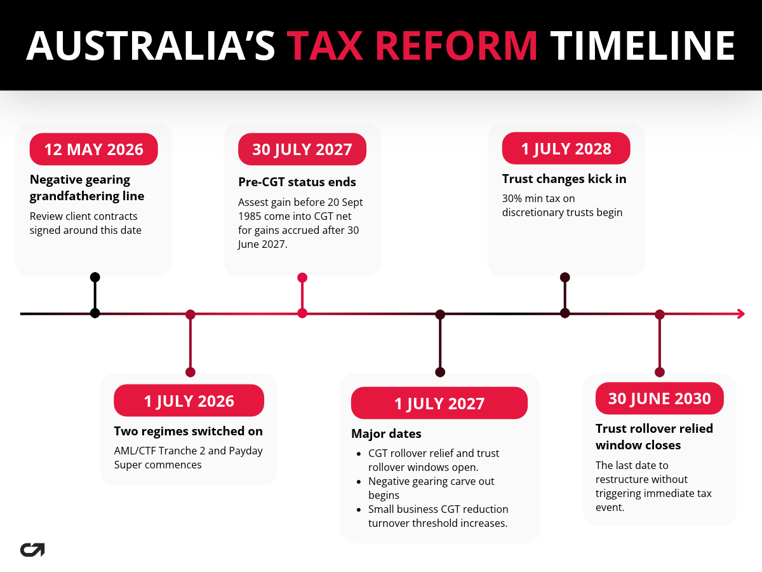
- 12 May 2026, negative gearing grandfathering line. Properties held or under contract before this date keep full negative gearing indefinitely. Those acquired after are unaffected until 1 July 2027. Review any client contracts signed around this date now.
- 1 July 2026, AML/CTF Tranche 2 commences. Your AML/CTF program must be in place and operating. Firms have 28 days from their first designated service to register if they haven't already.
- 1 July 2026, Payday Super commences. Contributions must reach employee funds within 7 business days of each payday, replacing the quarterly cycle. Your clients who are employers must have their payroll cadence and working capital checked.
- 30 June 2027, Pre-CGT status ends. Assets acquired before 20 September 1985 come into the CGT net for gains accruing after 30 June 2027, for the first time in 42 years.
- 1 July 2027, the heaviest date.
- CGT: 30% min Assets needing a market valuation to establish their new cost base should be valued on this date. This is also when the trust rollover relief window opens.
- Negative gearing carve-outs begin.
- Small business 50% CGT reduction turnover threshold rises to $10 million.
- Trust rollover window opens
- 1 July 2028, the 30% minimum tax on discretionary trust distributions begins. The law is still being finalised, so double-check. Should the date stand as proposed, then exposed trusts might be restructured before this date.
- 30 June 2030, the trust rollover relief window closes. The last date to restructure a trust without triggering an immediate tax event.
Because the busiest of these dates cluster around year end, working through a structured EOFY checklist with each business client keeps the FY27-specific tasks moving alongside the usual end-of-year work, rather than competing with it.
3. AML/CTF Tranche 2: you're now a reporting entity
This is the single biggest regulatory change to hit the profession since GST. On 1 July 2026, accounting firms that provide designated services became reporting entities under the AML/CTF Act, with the same core obligations that banks have carried for years.
The Act lists nine designated services. In everyday terms, they cover the bread-and-butter work most firms do:
- Managing client money or assets
- Setting up or administering companies and trusts
- Acting as a registered office
- Advising on or executing certain transactions.
If your firm does any of this, you're in scope and must register or enrol as a reporting entity with AUSTRAC. You have 28 days from providing your first designated service to do so if you haven't already. Make sure you’re clear on what’s needed for AUSTRAC registration for accountants.
Overview of your AML/CTF obligations:
- Set out an AML/CTF Program and appoint a Compliance Officer
- Conduct Client Due Diligence including Know Your Business (KYB) and Know Your Client (KYC) checks and screening clients for sanctions and Politically exposed persons (PEP).
- Ongoing monitoring and reporting
- Staff training
- Record-keeping
Getting comfortable with AML/CTF compliance for accountants means treating this as a documented program, not a one-off checklist. Your obligations start before you render a single service, and they apply whether or not you have enrolled.
Customer due diligence must be complete before the designated service begins, which fundamentally changes your engagement process. Because compliance must come before engagement, updating your firm’s engagement letter software is critical to ensure proper identity verification is conducted before any work begins.
Check out EngageAML for compliant engagement letter software.
4. Capital gains tax: the biggest reform since 1999
Capital gains tax hasn't changed this fundamentally since the 50% discount was introduced in 1999. The reform proposed in the FY2026-27 Federal Budget touches nearly every client file that holds a capital asset, so it needs a systematic response from accountants rather than a case-by-case scramble.
What’s changed?
- The flat 50% CGT discount is being replaced by an indexation system, and a new 30% minimum tax layer applies on top.
- The blanket exemption for assets acquired before 20 September 1985 ends after 30 June 2027. Gain accrued to that date remain exempt, but everything after is taxable.
In practice, this means:
- The same asset, held for the same period, can now produce a different tax outcome depending on when it was acquired and how it's held.
- Every affected client needs sorting into one of three classes, each treated differently.
- You can't assume last year's treatment still applies to any file.
Which CGT class is your client in?
| CGT Class | Treatment |
| Class 1 Pre-Budget assets Acquired before 12 May 2026 |
Hybrid: 50% discount on gains before 1 July 2027. Indexation + 30% minimum on gains after 1 July 2027. Pre-1985 assets: gains before 1 July 2027 remain exempt; gains after 1 July 2027 are taxable. |
| Class 1 Pre-Budget assets Acquired before 12 May 2026 |
50% discount on gains arising before 1 July 2027 only. Everything after 1 July 2027 falls under indexation + 30% minimum. For any asset held more than 2-3 years, the economic outcome is almost indistinguishable from buying post-July 2027. |
| Class 3 Post-Transition From 1 July 2027 |
Indexation only. Cost base adjusted by CPI each year. Tax is levied on the real gain (above inflation) only. 30% minimum tax applies on the net capital gain regardless of the investor's marginal rate. No 50% discount available. |
What to do?
The date to act on now is 1 July 2027, the valuation deadline.
Assets that need a market valuation to establish their new cost base will require a qualified valuer, and with every firm in the country working to the same date, the valuer pool will be under real pressure as it approaches.
Firms that flag valuation-need clients a year out will get them valued early and on their own timetable. The ones that delay until mid-2027 will be competing for scarce appointments.
There's genuine advice value in the detail:
- Small business CGT concessions still apply with a higher turnover threshold. The threshold change applies to that concession only, not to the 15-year exemption, retirement exemption or rollover. For eligible business clients, this can offset a substantial part of a gain, maybe even more than before the changes.
- For a client who would rather not sell an asset outright, CGT rollover relief can allow a restructure or transfer without triggering a full CGT event straight away.
- Loss ordering changes too. Capital losses must now be applied against discounted gains before non-discounted gains, removing the choice taxpayers previously had. Any loss harvesting strategy built on that choice needs revisiting.
5. Discretionary trusts: the 30% minimum tax
NOTE: The draft law for trust tax changes is still under consultation. This section will be updated accordingly whenever new information is available.
Almost every firm has trust clients, which makes this both the largest advisory opportunity of FY27 and the reform most likely to produce an awkward conversation with a long-standing client. As the law is still being drafted, your best approach as an accountant is to prep for what’s coming. You can lay the groundwork now so that when the law is passed, your clients already know what their gameplan is.
What will change?
From 1 July 2028, a 30% minimum tax will likely apply to distributions from discretionary trusts, with certain trusts excluded. To let firms restructure clients out of an exposed position without triggering an immediate tax event, a rollover relief window is proposed between 1 July 2027 and 30 June 2030. Three years sounds generous until you count how many trust files a typical firm has to work through inside it.
What can you do?
Start with triage, not restructuring. The first job is to separate the trusts genuinely exposed to the new tax from those that are fine exactly as they are, because not every trust needs to move.
Exposure is determined by what kind of trust it is and what kind of income it earns. Every non-excluded discretionary trust is in scope. What varies is the cost: beneficiaries already above 30% are broadly neutral, beneficiaries below 30% lose the benefit, and corporate beneficiaries are hit hardest.
Corporate beneficiaries get no credit for the minimum tax, so trust income routed to a bucket company is taxed twice: 30% at trustee level plus the corporate rate, an effective 60%, or around 70% once it is franked out to a shareholder on the top marginal rate. If your firm runs bucket company distributions as standard, that strategy needs redesigning, not adjusting
Then have the conversation. A workable structure is to open with the change, quantify what it costs that specific client, lay out the restructure-or-stay choice clearly, and agree a next step in the same meeting.
Expect three predictable pushbacks, and have an answer ready for each:
- The cost of restructuring
- Emotional attachment to a structure they've held for decades or you advised them to set up
- A "let's wait and see" reflex
Three technical areas come up constantly once restructuring is on the table:
- Loans and entitlements. Unpaid present entitlements and related-party loans mean you'll be working with Division 7A rules on loans, rates and compliance, and getting the paperwork right depends on a properly drafted Division 7A loan agreement rather than a generic template. When you're modelling repayments live with a client, a Div7A calculator using the benchmark rate lets you show the numbers in the room.
- The deed itself. Before any restructuring decision is finalised, a trust deed review confirms the existing deed actually permits what you're planning.
- State duties on the deemed or actual disposal of different asset types. This is a hotly debated issue that can make or break the value of the amnesty period.
6. Negative gearing: restricted to new builds
Unlike the other Budget measures, the negative gearing changes are already law. But they do not come into effect until 1 July 2027. Additionally, Budget night of 12 May 2026 is an important grandfathering line. Whichever side your client’s contract falls on determines what they can do about these changes.
What changed?
Negative gearing is now restricted to newly built dwellings, that is, properties built after 12 May 2026. Established properties purchased or contracted for after Budget night lose access to negative gearing deductions, while arrangements already in place are grandfathered.
The catch is in the detail: what counts as grandfathered, and which exemptions apply, has to be checked against each client's actual contract dates rather than assumed from the headline rule. And remember, the negative gearing restrictions start only on 1 July 2026.
This is a residential-only measure. Out of scope are: widely held trusts and managed investment trusts, superannuation funds including SMSFs.
What to do?
The urgent task is reviewing existing contracts. Any client who was mid-purchase around Budget night, or who signed a contract close to it, needs their position checked now, while there's still room to act, rather than at tax time next year when the outcome is locked in.
A short, factual client alert, sent proactively this week rather than drafted from scratch when someone asks, is usually the fastest way to surface anyone affected. Because a client's negative gearing position rarely sits in isolation from the rest of their affairs, this measure is best handled as one part of the wider tax planning conversation rather than a standalone alert.
7. Business and tax system changes
Beyond the headline reforms, a set of system-level changes affects how you advise business clients on the day-to-day running of their business. None of these is as seismic as CGT or trusts, but together they shape a lot of routine advice.
What changed?
- The instant asset write-off is now permanent. From 1 July 2026, this is no longer a use-it-or-lose-it measure tied to a single Budget, which changes how you'd frame the timing of a client's equipment and asset purchases across years rather than months. The $20,000 instant asset write-off is being made permanent from 1 July 2026 for small businesses with aggregated turnover up to $10 million, ending the cycle of annual extensions.
- Loss carry-back reintroduced, but watch the franking trap. Carrying a loss back against previously taxed profits can leave a company short of franking credits when it later wants to pay a franked dividend, so the two decisions need to be modelled together, not in isolation.
- PAYG instalments move to a monthly opt-in from 1 July 2027 for eligible businesses. It’s a cash-flow timing decision worth raising with clients who have historically paid quarterly.
- Payday Super changes require that superannuation guarantee (SG) contributions must reach your employees’ fund within 7 business days of each payday. It is a cadence and working capital change for your employer clients.
- $1,000 instant work-related expense deduction applies from FY27, removing the need to itemise below that threshold. Donations, union fees and other non-work deductions sit on top. It will change the substantiation conversation and economics of preparing those returns for a large share of your individual clients.
FBT Guide
Fringe benefits tax is a growing part of the business-client conversation too, and it deserves its own attention rather than a footnote. Our full FBT guide for accountants covers the rates, dates and client reviews end to end. It includes guidance on electric vehicle FBT exemptions, FBT entertainment rules, and FBT motor vehicle treatment and novated leases.
8. Turning compliance pressure into advisory revenue
If you’ve made it this far in this accountant’s guide, it’s probably easy to see these reforms as a burden. Given the administrative load, that’s understandable.
But reframed properly, these changes present one of the best advisory opportunities most firms will see this decade. That’s because every obligation above is also a conversation a client will pay for.
These are the recurring service lines that fall straight out of the FY27 reforms:
- Pre-acquisition CGT modelling, before a client buys or sells a major asset
- Trust restructuring reviews, inside the rollover relief window
- Entity comparison and structuring advice
- Valuation coordination ahead of the 1 July 2027 deadline for CGT changes
- Negative gearing contract reviews
- Payday Super readiness and concessional cap remediation
- Ongoing AML/CTF compliance, on retainer or time and materials
The demand is already sitting in your client book. You just have to act on it swiftly and systematically.
The difference between offering these and profiting from them comes down to how you package and price them. Mapping each service line against the FY27 timeline gives you a natural reason to raise it at the right moment. That’s a CGT modelling conversation before the valuation deadline or a restructuring review while relief is still available, so the advice lands as timely rather than opportunistic.
Read our article on Accounting Firm Pricing Strategies to take the guesswork out of your repricing conversations. Implement a model that reflects the real complexity, risk and value of your work.
9. Thrive in FY27: The accountant’s toolkit
Your obligations are clear. The practical question is what carries the load once you've worked out what needs doing, because no firm gets through a year like this on manual effort alone.
FY27's real difficulty isn't a single big task; it's hundreds of small ones spread across the whole client book and staggered over four years of deadlines. Getting through it depends less on any one heroic push than on the tooling that stops things slipping through the cracks, and each tool should earn its keep.
After all, your team shouldn’t have to pull extra hours or work nights just to carry the extra load. As much as you work hard to give your clients the best advice possible for a financially secure, quality life with their loved ones, your team deserves the same.
Tax planning software
Tax planning software is where the CGT and trust reforms actually get worked. Sorting clients into their new CGT class, running a hold-or-sell scenario, or modelling what the 30% minimum tax will cost a particular trust are calculations you'll repeat across dozens of files, and the best tax planning software turns them from a one-off spreadsheet into a repeatable, client-ready process.
Workpapers are the other half of that. With AML/CTF putting firms under real scrutiny and every CGT and trust decision now needing a documented rationale, clean and consistent accounting workpapers are the audit trail that proves the work was done properly.
Workflow tooling
With so many deadlines staggered across the client book, the right accounting workflow software tracks which client sits at which stage so no deadline or window ever slips past unnoticed.
Critically, the practice management software beneath all of it holds the client record together, so you can see at a glance who has a trust, who needs a valuation and who is mid-contract on a property, instead of reconstructing it one file at a time.
Stay updated to give your clients the best advice
FY27 is heavier than most years. But every obligation in it has a clear action and a tool behind it, and the firms that plan the year rather than react to it will come out of it with stronger client relationships and a genuinely bigger advisory business.
Bookmark this accountant’s practical guide and work through section by section as each date approaches. Check back as we update it through the year with the latest information, guidance, and resources.
